
At 8:12 on a Tuesday morning, a customer walked in with the kind of look we see when a phone isn’t just a phone anymore – it’s work, banking, family photos, school logins, two-factor codes, and a whole day about to go sideways. Her iPhone had gone black after a charging issue, and another shop had already told her the board was done. This iphone motherboard repair success story starts where a lot of people lose hope: after the screen won’t turn on, after the charger swap doesn’t help, and after someone says, “You probably need a new phone.”
That advice is common. It’s also not always right.
Why this iPhone motherboard repair success story matters
Most customers don’t come in asking for board-level repair. They come in saying the phone won’t charge, won’t boot, gets hot, has no backlight, or keeps restarting at the Apple logo. From the outside, those symptoms can look random. On the inside, they often trace back to one damaged component, one shorted line, or one failed area on the logic board.
That distinction matters because replacement is expensive, data transfer is not guaranteed, and many people just want their original device working again. If the motherboard can be repaired, the customer may avoid the cost of a new phone, keep their data in place, and get back to normal faster. That’s the real value of microsoldering. It’s not about showing off technical skill. It’s about saving the device that holds your life.
In this case, the phone had already been tested with a known-good charging cable and power source. It still showed no normal charging behavior. The customer had noticed one more clue: before it died completely, the phone would sometimes charge only if the cable was held at an angle. That can point to a charging port problem, but it can also mean board damage related to power delivery. It depends on what failed first.
The symptoms looked simple. The fault wasn’t.
When a dead iPhone comes in, the first step is not to guess. It’s to verify the basics fast and then go deeper only if the device needs it. A screen issue, battery failure, charging port damage, or software crash can mimic board failure. Good repair starts with ruling out the obvious before touching the board.
This device passed through the normal front-end checks. A replacement screen didn’t restore image. A known-good battery didn’t bring it back. The charging port was not the root cause. Power draw behavior suggested the phone was trying to start, but not completing the process. That’s where standard repair stops and microsoldering begins.
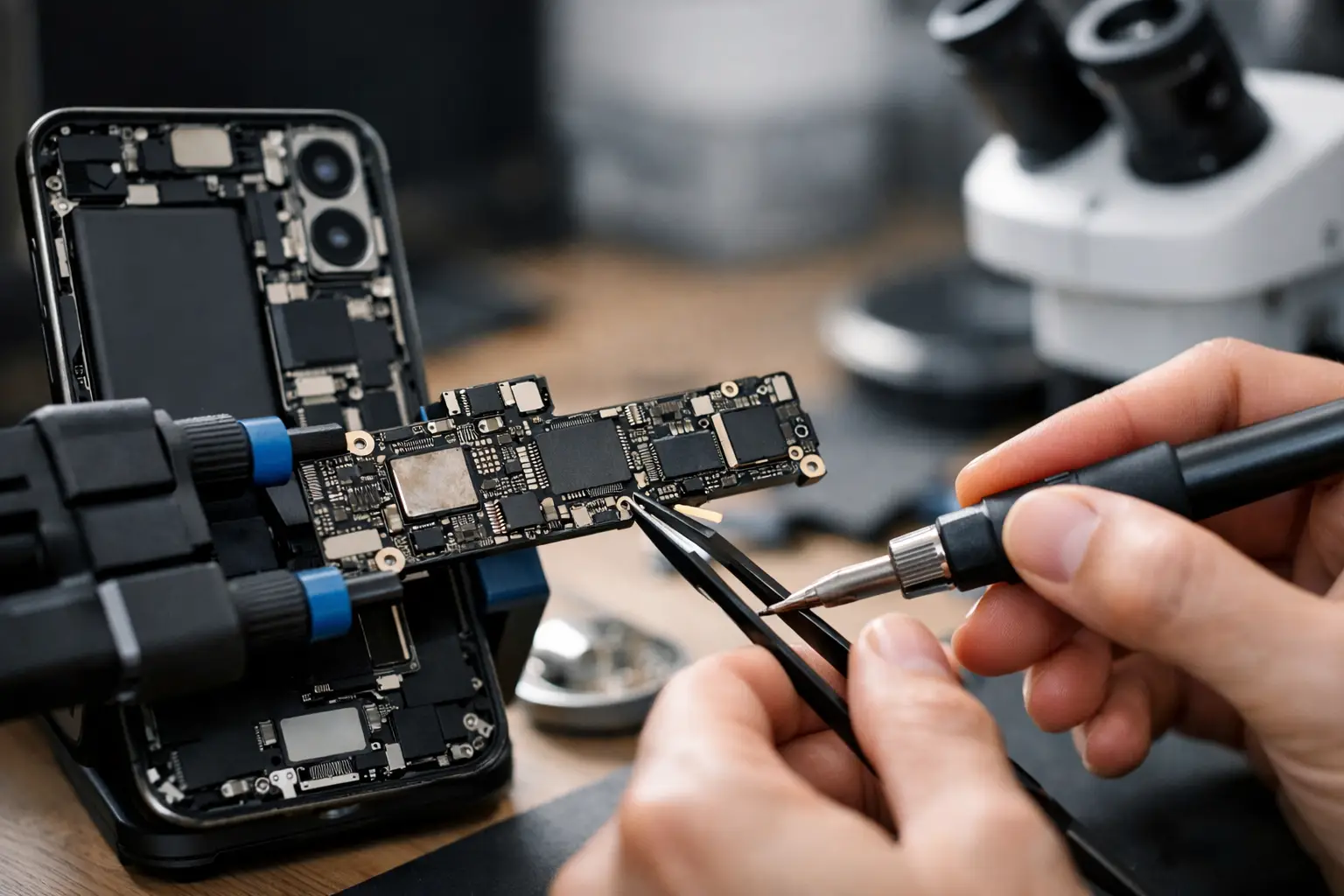
Once opened and inspected under magnification, the board showed signs of localized damage near a power-management area. No dramatic burn mark. No movie-scene damage. Just a failed component chain causing the phone to stall during startup. That’s how motherboard faults usually look in the real world – small problem, big symptoms.
What motherboard repair actually means
A lot of people hear “motherboard repair” and picture replacing the whole board. On an iPhone, that usually means replacing the logic board, and that creates a different set of problems. Depending on the model, pairing issues, security features, and data loss can all come into play.
True board repair means identifying the bad section, tracing the fault, and repairing that area at component level when the device is a good candidate. It can involve replacing filters, capacitors, connectors, ICs, or repairing damaged pads and traces. It requires tools most quick-repair counters don’t use every day and patience most customers shouldn’t have to pay for unless it’s necessary.
That’s also why not every “dead phone” should go straight to board work. Sometimes a battery replacement solves it. Sometimes a charging port does. Sometimes liquid damage has spread too far and the honest answer is that repair may not be cost-effective. The right shop tells you which situation you’re in before you spend money chasing a bad outcome.
The repair that changed the outcome
In this iphone motherboard repair success story, the failure came down to a damaged board-level component in the phone’s power path. After isolating the fault, the technician removed the failed part, cleaned the area, tested surrounding lines, and installed the replacement under microscope. Then came the moment that matters more than the solder joint itself: reassembly and power test.
The phone booted.
That doesn’t always mean the job is over. A successful board repair still needs charging verification, thermal checks, battery response, and stability testing. A device that powers on for 30 seconds and dies again is not a success. A device that charges properly, boots consistently, connects to signal and Wi-Fi, and stays stable through testing is.
This one passed. The customer got her photos, messages, work apps, and account access back on the original phone. She did not need to buy a replacement that day. She did not need to hope a backup existed somewhere. She needed a working device, and that’s what mattered.
Why some shops say “not repairable” too early
There are fair reasons a shop may decline motherboard work. Board repair takes specialized equipment, training, and time. It carries more diagnostic complexity than a screen or battery replacement. If a shop doesn’t offer microsoldering, saying no is better than pretending.
But there’s another reality: some phones get written off because replacement is simpler to sell. That’s not always the better move for the customer.
If your iPhone has no power, no image, no charge, boot looping, or post-liquid-damage issues, you want a diagnosis before a sales pitch. You want someone to determine whether the failure is a basic part, a board issue, or a full replacement case. Speed matters, but accuracy matters first. Fast wrong answers still cost you time.
When board repair is worth it
Not every phone should be repaired at motherboard level. If the device is very old, badly bent, heavily corroded, or has multiple failures stacked together, replacement may make more sense. If the cost of board repair approaches the value of the phone, the choice gets more personal.
Still, there are plenty of cases where board repair is the smart move. Newer iPhones, phones with critical data, devices tied to work accounts, and phones with otherwise good screens and batteries are often worth serious evaluation. The customer in this story didn’t care about the phrase “logic board microsoldering.” She cared that her phone had value and that losing it would create a bigger problem than the repair bill.
That’s the decision most people are actually making.
What customers should do before giving up on a dead iPhone
If your iPhone suddenly dies, don’t keep force-charging it, don’t leave it on a cheap charger hoping it wakes up, and don’t assume the first diagnosis is final. If the phone got wet, power it down and stop testing it. If it overheats, disconnect it. If another shop says the board is gone, get a second look from a team that actually handles board-level diagnostics.
A good repair path is straightforward: confirm the symptom, rule out common parts, test the board, quote the repair honestly, and move fast if the device is a solid candidate. That approach saves time and cuts down on wasted spending.
For customers around Warner Robins and Middle Georgia, that matters even more because most people are not looking to mail a phone off for days just to hear maybe. They want a real answer from technicians who can handle the full range, from charging ports and batteries to advanced motherboard work.
Reboot Hub has built its reputation on exactly that kind of urgency – fast diagnostics, fair pricing, certified technicians, and repairs backed by warranty when the device qualifies. That’s what people need when their phone stops being convenient and starts becoming a problem.
A good repair is more than a saved device
The best part of an iPhone motherboard repair success story is not the microscope work. It’s the moment a customer realizes they don’t have to start over. Their logins still work. Their contacts are still there. Their photos open. Their normal day comes back.
That’s why board repair matters. Not because every phone can be saved, and not because every case should be. It matters because some devices are called dead before they’ve had the right diagnosis. When the problem is fixable, the right repair can beat replacement on cost, speed, and peace of mind.
If your iPhone looks done, that may be true. It may also be one damaged component away from working again. The only way to know is to have it checked by people who repair the problem in front of them, not just the easy parts around it.