
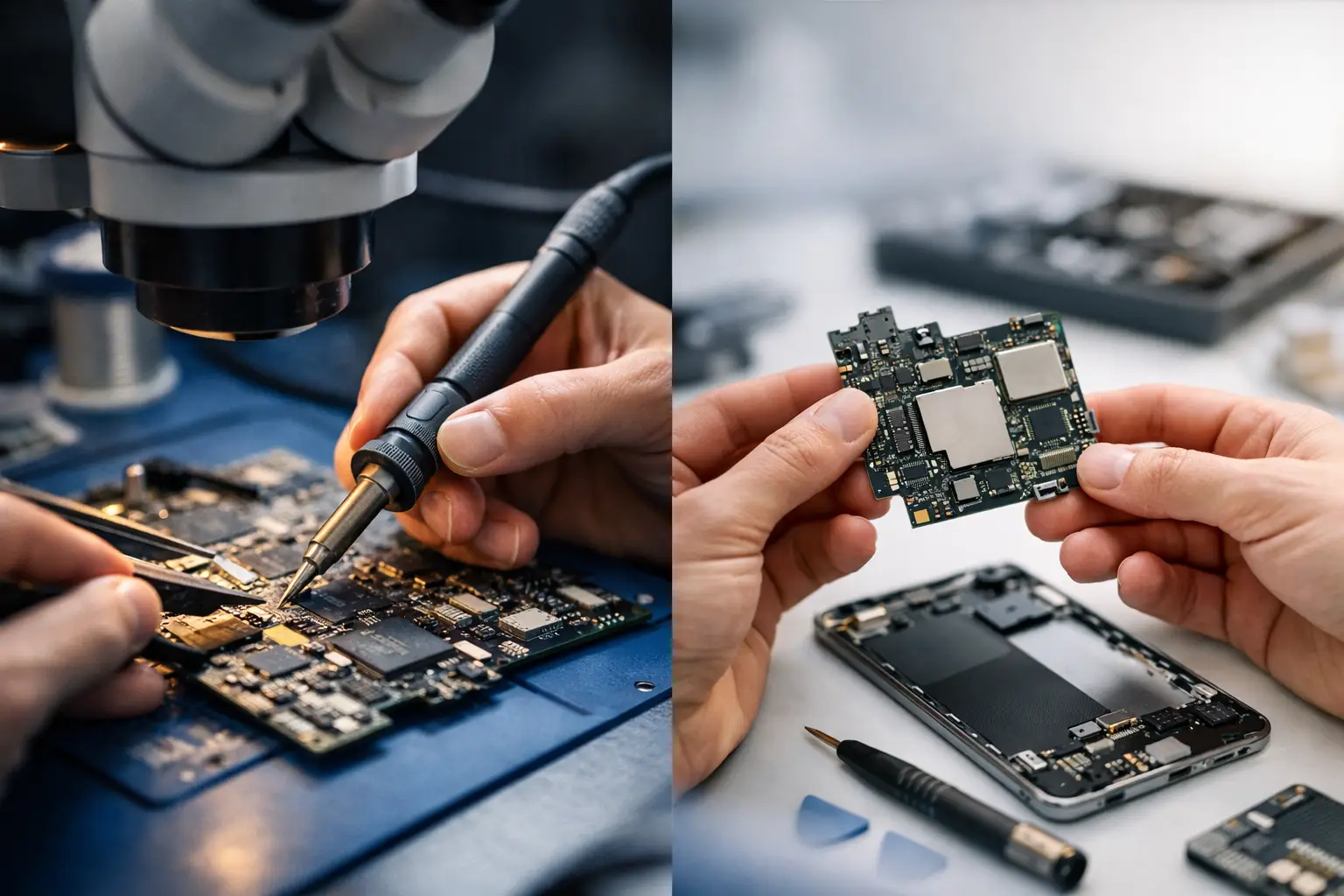
A phone that will not charge, a game console with no display, or a laptop that suddenly went dead usually leads to one question at the counter: should you repair the board or replace it? That is where microsoldering vs board replacement becomes a real decision, not just a technical term. The right choice can save your data, cut repair costs, and get you back up and running faster.
What microsoldering vs board replacement really means
Microsoldering is board-level repair. A technician uses specialized tools, magnification, and precision heat to remove and replace tiny damaged components on the motherboard. That might be a charging IC, a blown capacitor, a damaged connector, or corrosion caused by liquid exposure.
Board replacement means swapping the entire logic board or motherboard with another one. In some cases, that is a brand-new board. In others, it is a refurbished or donor board pulled from the same device model.
For customers, the difference is simple. Microsoldering aims to fix the exact failed part. Board replacement skips that step and changes the whole board instead.
Why this choice matters more than most people think
The board is the brain of the device. On many phones, tablets, laptops, and consoles, it also ties directly to important functions like Face ID, Touch ID, network performance, charging, audio, and storage access. On some devices, the board is closely linked to your data.
That means the repair path affects more than price. It can affect whether your photos are recoverable, whether security features still work, and whether your device keeps its original identity and internal pairing.
A cracked screen is usually straightforward. A bad board is not. That is why a real diagnosis matters before anyone quotes a final answer.
When microsoldering is usually the better option
Microsoldering often makes the most sense when the damage is limited to one area of the board. A common example is a phone that stopped charging after a cheap cable damaged the charging circuit. Another is water damage that affected a few components near a connector but did not destroy the entire board.
This route can also be the best move when data matters. If your board still holds the original storage and core functions can be restored, microsoldering may preserve access to photos, messages, business files, and app data that might be lost with a full board swap.
Cost is another reason. Replacing a few failed components is often cheaper than sourcing a full motherboard, especially on newer devices where boards are expensive and harder to find.
There is also a quality advantage when done correctly. Keeping the original board means you avoid some of the compatibility issues that can show up with donor boards, including activation problems, missing features, or parts pairing conflicts on certain devices.
When board replacement makes more sense
Sometimes the board is simply too far gone. Severe liquid damage, burn damage, broken layers inside the board, or multiple failed circuits can turn a targeted repair into a long shot. In that case, board replacement may be faster, more predictable, and more cost-effective.
It can also be the better answer when a matching board is readily available and the customer does not need data from the original device. If the main goal is getting the device functional again as quickly as possible, replacement may win on turnaround.
There are cases where previous repair attempts change the equation too. If someone already worked on the board, lifted pads, damaged traces, or overheated key areas, microsoldering becomes more complex and less certain. Replacing the board may be the safer route.
The biggest trade-off: data
This is where many people make the wrong call because no one explained the stakes clearly.
If you replace the board in many phones or tablets, you are often replacing the part that stores your data or controls access to it. Unless your information is fully backed up, board replacement can mean losing what was on the device.
Microsoldering, on the other hand, is often the best chance to recover a customer device without giving up the original data. That is especially important after water damage, power failure, or no-boot conditions where the customer cares more about the content than the hardware.
If your device contains work files, family photos, or business apps you cannot easily restore, make that clear before any repair starts. It should shape the recommendation from the beginning.
Cost, speed, and reliability – the real-world comparison
Customers usually care about three things: how much it costs, how fast it gets done, and whether it will last.
Microsoldering can be cheaper than board replacement when the fault is isolated. But it is not always the fastest option because the device has to be diagnosed at a deeper level. The technician needs to test circuits, inspect the board under a microscope, and confirm exactly what failed.
Board replacement can be quicker if the right board is in stock and installation is straightforward. But that speed disappears if the board is expensive, backordered, or needs programming and pairing after installation.
Reliability depends less on the category of repair and more on the quality of the work. A properly completed microsoldering repair can last just as well as any other internal repair. A poorly sourced replacement board, on the other hand, can create new issues you did not have before.
That is why experience matters. Board-level work is not guesswork. It takes the right equipment, testing process, and technicians who know what they are looking at.
Microsoldering vs board replacement for common problems
For charging issues, microsoldering is often the smart move if the fault is tied to the charge port circuit, filters, or power management components. If the board has broad power failure across multiple rails, replacement may be more practical.
For water damage, it depends on how far the corrosion spread. Early intervention often makes microsoldering worthwhile. Waiting too long can allow corrosion to travel and damage more of the board, which pushes the repair closer to replacement.
For no power or boot loop issues, the answer depends on diagnosis. Some are caused by one shorted component. Others point to deeper board failure. That is why two devices with the same symptom can need completely different solutions.
For game consoles and laptops, board-level repair is often a strong option because common faults may involve HDMI circuits, power sections, backlight circuits, or damaged ports. Full board replacement on these devices can get expensive quickly.
How a good repair shop decides
A good shop does not push board replacement just because it is easier to explain. It also does not promise microsoldering on every dead device just to get the job in the door.
The right process starts with diagnosis. What failed? How isolated is the damage? Is data a priority? What is the cost of parts versus labor? Is there a realistic path to a stable repair?
At Reboot Hub, that practical approach matters because speed only helps if the answer is the right one. Some devices can be repaired fast at the component level. Others need a board replacement to avoid wasting your time and money. The point is to give you the fix that makes sense, not the one that sounds easiest.
Questions to ask before you approve either repair
Ask whether your data will be preserved. Ask whether the repair keeps the original board. Ask whether the issue has been fully diagnosed or if the quote is still preliminary. Ask whether all major features are expected to work after repair, including charging, cameras, wireless functions, and biometric security where applicable.
You should also ask about warranty coverage. Board work is specialized, and a confident shop should be able to stand behind what it repairs.
Which option is better?
If the damage is targeted, your data matters, and the board is repairable, microsoldering is often the better value. If the board has widespread failure, the repair would be too uncertain, or a replacement board makes more financial sense, board replacement may be the smarter call.
The key is not choosing the cheaper-sounding option on the spot. It is getting a real diagnosis from technicians who do this work every day and can explain the trade-offs in plain English.
When your device is essential to work, school, gaming, or daily life, the best repair is the one that gets you back to normal fast without gambling with your money or your data. If you are facing that decision now, get the board checked before you assume the whole device is done for.