
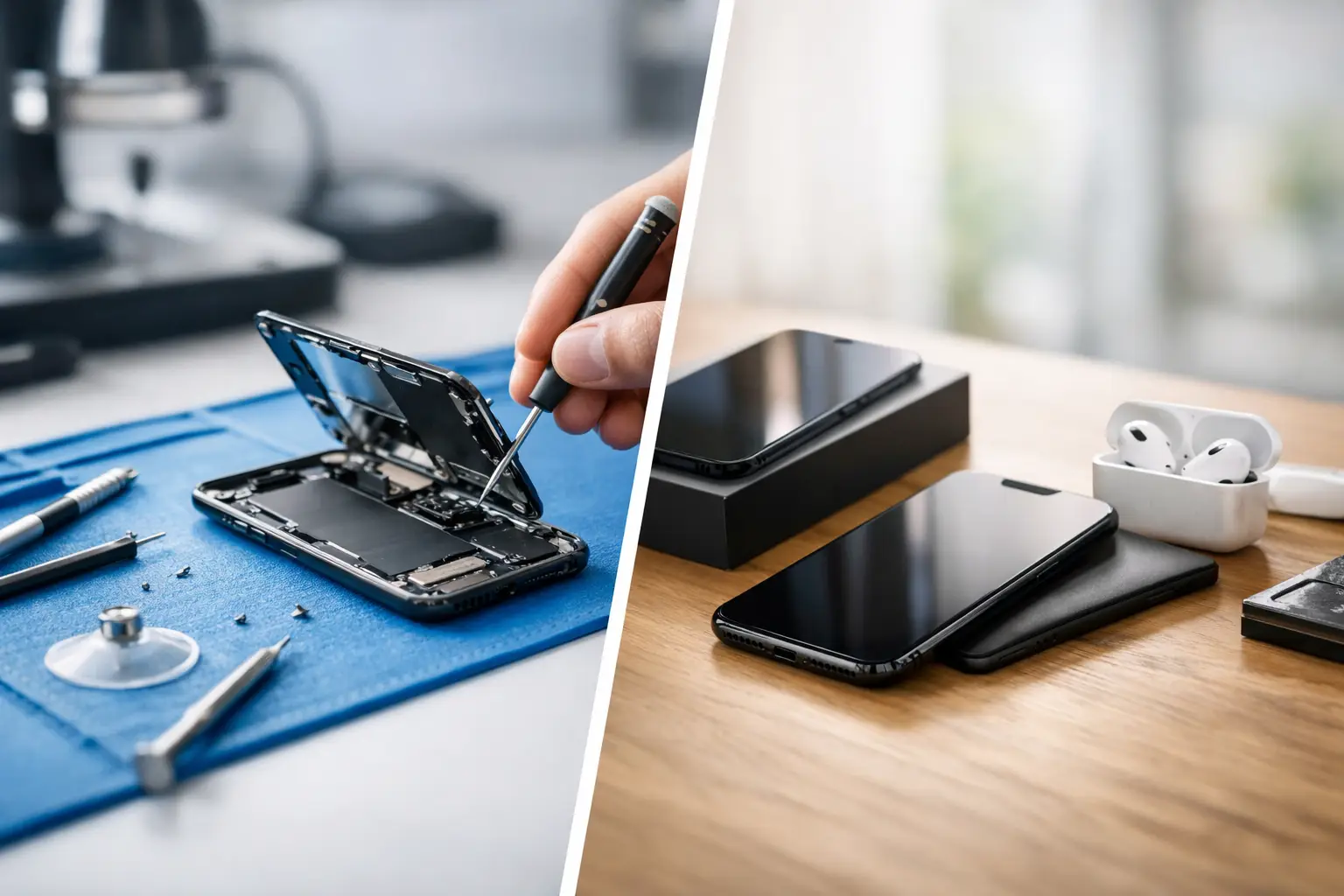
Your iPhone hits the floor, the screen spiderwebs, and suddenly you are making a repair or replace iPhone decision faster than you ever wanted to. For most people, this is not really about the phone. It is about cost, downtime, and how quickly life gets back to normal.
That is why this choice should be practical, not emotional. A cracked screen can look terrible and still be an easy fix. A phone that powers on and off, will not charge, or has face recognition issues may still be worth saving. On the other hand, some problems are warning signs that putting more money into the device does not make sense.
How to make the repair or replace iPhone decision
Start with three questions. What is broken, how much will it cost to fix, and how much useful life will you get after the repair? If you can answer those honestly, the decision gets a lot easier.
A lot of iPhone damage looks worse than it is. Front glass damage, battery wear, charging port issues, weak speakers, and camera problems are often repairable without replacing the whole device. Even some board-level failures can be fixed by a shop with microsoldering capability. If the repair restores your phone to solid daily use for a reasonable price, repairing is usually the better move.
Replacement makes more sense when the phone has multiple major failures at once. A badly cracked screen, poor battery health, water damage, and charging issues together can add up fast. At that point, you are not paying for one repair. You are stacking repairs on a device that may already be near the end of its practical life.
When repairing your iPhone is the smart move
If the phone is only dealing with one clear issue, repair usually wins.
A cracked screen is the easiest example. If everything else works well, replacing the screen is almost always cheaper than buying another iPhone. The same goes for a battery that drains too fast. Battery replacement can give an otherwise healthy phone a second life, especially if the device still runs your apps well and gets current software support.
Charging problems are another common case. People assume the battery is dead or the phone is done, but sometimes the issue is a worn charging port, debris packed into the port, or a part failure that can be diagnosed quickly. A proper inspection matters because guessing gets expensive.
Repair also makes sense when your phone holds value beyond the hardware. Maybe it is already paid off, fully set up for work, and still performs fine. Maybe you do not want the hassle of transferring data, redoing logins, reconnecting banking apps, or losing time shopping for a replacement. The cheaper invoice is not the only savings. Avoiding downtime matters too.
For local customers around Warner Robins and Middle Georgia, speed can tip the scale even more. If you can get the device repaired the same day instead of dealing with shipping delays or setting up a new phone, that convenience has real value.
When replacing your iPhone makes more sense
There are times when replacing is simply the cleaner decision.
If the phone has severe water damage, the answer depends on what got affected. Some water-damaged devices can be recovered, especially when they are brought in quickly and handled by technicians who do more than basic parts swaps. But if corrosion has spread across the board and key functions keep failing, replacement may be the safer long-term call.
Age matters too. If your iPhone is already several generations old, repair costs take up a larger share of the phone’s remaining value. A battery replacement on an older phone can still be worth it. A battery, screen, and charging repair on that same phone may not be.
Performance is another factor people ignore. If the device is already sluggish, struggles with storage, and no longer fits how you use it, fixing one hardware issue may not solve the bigger problem. You do not want to pay to repair a phone you already find frustrating.
And then there is repeat damage. If this is the second or third major repair in a short period, replacement starts looking more sensible. That is not because repair is bad. It is because the total investment over time may no longer be smart.
A simple cost rule that helps
A good rule of thumb is this: if the repair cost is low compared to the replacement cost and the phone should still serve you well for another year or more, repair it.
If the repair cost gets close to what you would pay for a reliable replacement, pause. That is where many people overspend. They focus on getting the current problem fixed without stepping back to look at the bigger number.
The key phrase there is reliable replacement. Comparing repair cost to a brand-new flagship model can make any repair look cheap. That is not always the real choice. The real comparison is often between repairing your current phone and buying a dependable replacement device that fits your budget.
The hidden costs people forget
The repair or replace iPhone decision is not just about parts and labor. It is also about risk.
Replacing a phone often means setup time, activation issues, data transfer, accessory compatibility, and the chance that a used replacement comes with its own problems. A lower sticker price does not always mean lower total cost.
Repair has its own risk too, especially if the shop is using low-quality parts or cannot properly diagnose the issue. That is why warranty matters. A strong lifetime warranty changes the math because it lowers the risk of paying twice for the same problem. Certified technicians matter for the same reason. You want the repair done right the first time, not patched together just long enough to get out the door.
Signs you should repair now, not wait
Some iPhone issues get more expensive if you delay.
A swollen battery should not be ignored. A cracked screen can let in moisture and dust. Intermittent charging can turn into complete charging failure. Water exposure gets worse the longer corrosion sits inside the device. Waiting rarely saves money when the problem is already active.
Fast diagnosis is what saves money. That is one reason many customers choose a local repair shop instead of mail-in service. You get answers sooner, and you can make the decision based on the actual condition of the phone instead of guessing from symptoms.
How a professional diagnosis changes the decision
People often come in thinking they need a full replacement when the phone needs one targeted repair. Others assume the problem is minor when the device has deeper board damage. Without a real diagnosis, both groups are just guessing.
A good shop should be able to tell you what failed, what it costs to fix, and whether the repair is worth doing. Just as important, they should be willing to tell you when it is not worth it. That honesty matters more than a sales pitch.
At Reboot Hub, that is the standard. If your iPhone can be fixed fast and fairly, that is the recommendation. If replacement is the better value, you should hear that too. The goal is not to force a repair. The goal is to get you back to a working device with the least waste of time and money.
The best choice for most people
Most iPhone owners should repair when the problem is isolated, the phone still performs well, and the fix comes with solid warranty coverage. Most should replace when the device has multiple serious issues, weak remaining value, or a repair bill that gets too close to the cost of a dependable replacement.
That may sound simple, but it is the right kind of simple. You do not need a complicated formula. You need an honest look at the phone’s condition, the repair cost, and how long the device will realistically serve you after the fix.
If your phone is central to work, school, family, or daily life, speed matters too. The best decision is usually the one that gets you back up and running quickly without spending more than the device is worth. Start there, and the right answer gets a lot clearer.