
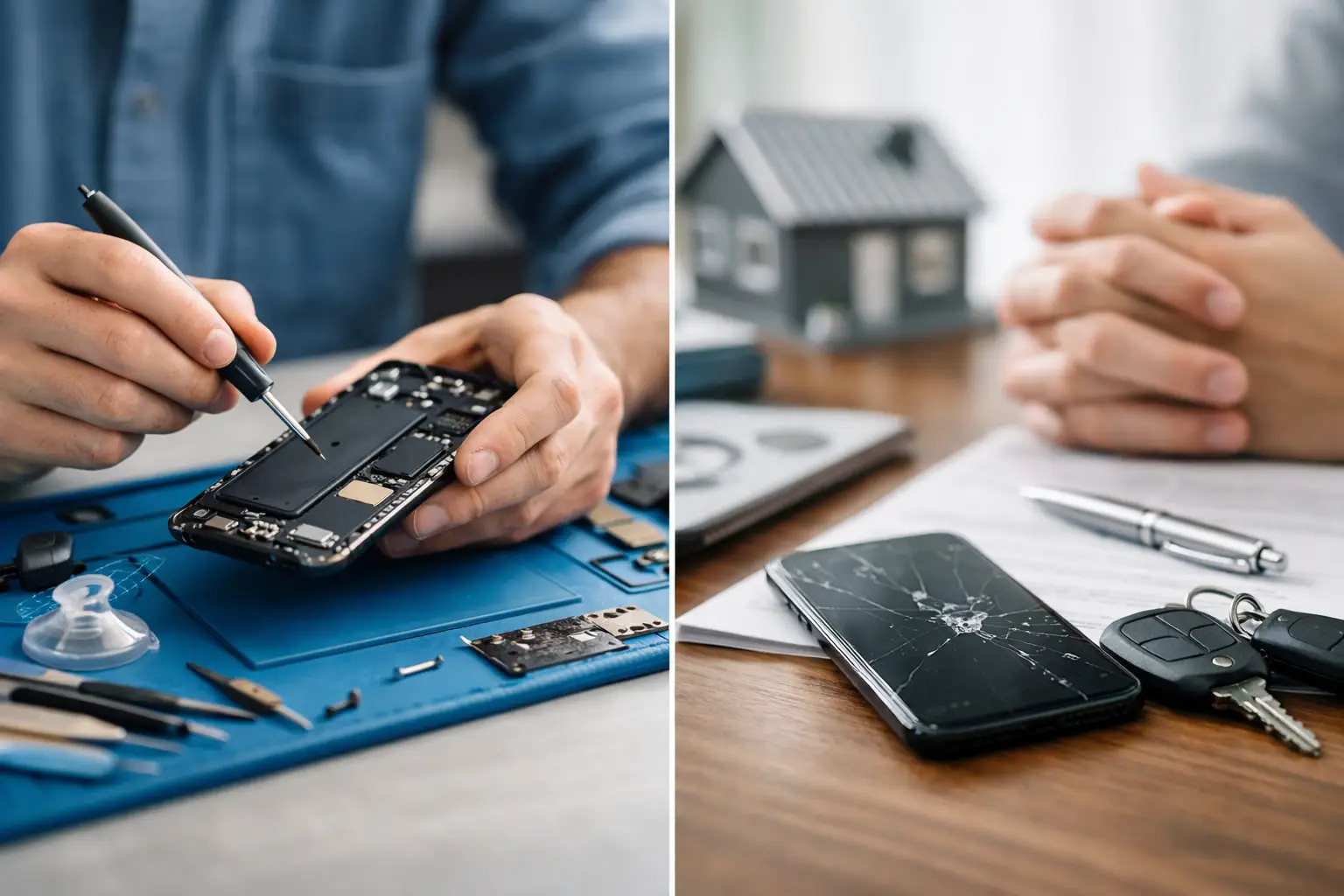
You drop your phone, the screen shatters, and suddenly you have two choices that sound simple but rarely are: phone repair versus insurance claim. One might get you back up and running today. The other might make sense on paper, then cost more time, more hassle, and a deductible that feels a lot less friendly once you see the total.
For most people, this decision comes down to three things – how fast you need your phone back, how much you will actually pay out of pocket, and whether the damage is even worth running through insurance. If your phone handles work, school, banking, messages, photos, and everything else in your day, downtime matters. A lot.
Phone repair versus insurance claim: what changes the answer?
There is no one-size-fits-all answer here. A cracked front screen on a newer iPhone is not the same as a water-damaged device that will not power on. A customer with a low deductible and premium coverage may have a different best option than someone with a high deductible and limited protection.
That said, local repair is often the better move when the damage is straightforward and the phone is worth saving. Screen replacement, battery replacement, charging port issues, speakers, buttons, and many camera problems can usually be fixed faster and more directly than an insurance claim. If the goal is simple – get your phone working again without dragging this out – repair usually wins on speed.
Insurance tends to become more attractive when the phone is lost, stolen, severely bent, or damaged beyond practical repair. It can also help when major internal damage pushes repair costs close to replacement value. The key is not assuming insurance is automatically the cheaper or safer path. Sometimes it is. Often it is not.
Start with the real cost, not the monthly premium
A lot of people think, “I already pay for insurance, so I should use it.” That feels logical until the deductible enters the chat.
Most phone insurance plans are built around monthly premiums plus a deductible each time you file a claim. Depending on the device and carrier, that deductible can be high enough that a local repair is the cheaper option, especially for cracked screens and battery issues. If your screen repair is less than or close to the deductible, filing a claim may not save you much at all.
There is also the hidden math of insurance. You may have been paying that monthly premium for a year or two already. That money is gone whether you use the plan or not. So the smarter question is not, “Do I have insurance?” It is, “What will this specific problem cost me to solve today?”
A direct repair quote gives you that answer quickly. No guessing, no claim portal, no waiting for approval. Just the real price to fix the problem.
Speed matters more than people expect
When customers compare phone repair versus insurance claim, they often focus on dollars first. That makes sense, but time is usually the bigger issue.
If insurance sends a replacement device, you may still wait days. If they require claim review, shipping, verification, or a device return, the process gets longer. Some plans move quickly. Some do not. Either way, it usually is not a true same-day answer.
A local repair shop can often fix common problems the same day, and in many cases much faster than that. If your screen is cracked at lunch and repaired before dinner, that is a very different experience from boxing up your phone, tracking a claim, restoring data, redoing settings, and hoping the replacement arrives on schedule.
For business owners, parents, students, and anyone who lives off their phone, downtime has a cost. Missed calls, delayed texts, two-factor login headaches, lost productivity, and the plain frustration of being without your device all add up fast.
Repair keeps your phone, insurance may swap it
This is a detail people often overlook.
With repair, you usually keep your actual device. That means your photos, apps, settings, passwords, eSIM setup, accessories, and general familiarity stay intact. Once the part is fixed, you move on.
With an insurance claim, there is a decent chance you end up with a replacement phone instead of your original one. That replacement may be refurbished. It may be equivalent, not identical. It may arrive with a different battery age, a different frame condition, or a different repair history than your original phone.
That is not always a bad deal. In some cases, it is the right one. But if your current phone is otherwise in good shape and only has one repairable issue, fixing the phone you already know can be the cleaner solution.
When phone repair is usually the smarter move
If the damage is limited and the device is still worth keeping, repair is often the practical choice. Cracked screens are the most obvious example. So are weak batteries, charging issues, bad speakers, non-working buttons, camera lens damage, and many signal or connectivity problems.
These are the kinds of repairs where speed and price matter most. A good shop can diagnose the issue, explain the fix, and get you back to normal without turning one broken part into a week-long process.
This is also where warranty matters. A strong repair warranty lowers the risk of choosing repair because you are not just paying for the part swap. You are paying for accountability after the job is done.
When an insurance claim makes more sense
There are situations where insurance is the better play.
If the phone is lost or stolen, repair is obviously off the table. If it has severe motherboard damage, heavy liquid damage, frame separation, or multiple major failures at once, an insurance replacement may be more reasonable than investing in an expensive rebuild. The same goes for devices that are already older and near the end of their useful life.
Insurance can also make sense if your plan has a surprisingly low deductible and the replacement terms are solid. That is why it pays to compare actual numbers instead of defaulting to one path.
Watch for the trade-offs nobody mentions upfront
Both options have fine print, just in different forms.
With repair, the biggest question is part quality and technician skill. Not every shop is equal. Fast only helps if the repair is done right. You want certified technicians, a clear warranty, and a shop with real experience on your phone model and issue.
With insurance, the trade-offs are usually process-related. Deductibles, claim limits, replacement inventory, delays, data transfer hassles, and refurbished device swaps can all affect the outcome. You may also be asked to return your damaged phone quickly or face extra charges.
Neither path is automatically perfect. The best choice is the one that solves your problem with the least total pain – cost, time, risk, and inconvenience included.
How to decide in five minutes
Start by asking for a repair quote before filing a claim. That gives you a concrete number. Then check your deductible, expected timeline, and whether insurance will repair your phone or replace it.
If repair is faster and the out-of-pocket cost is lower or close, repair is usually the better move. If the phone is gone, totaled, or the repair cost is too high relative to the phone’s value, insurance may be the smarter answer.
For people around Warner Robins and Middle Georgia, this is where a local shop has a real advantage. You can walk in, get the device looked at, and know what you are dealing with before committing yourself to a claim process.
The best phone repair versus insurance claim choice is the one that gets your life back
Most people are not trying to make a perfect technical decision. They just want their phone working again without overpaying or wasting days. That is why fast, local repair is often the first thing worth checking. A cracked screen, bad battery, charging issue, or even deeper board-level problem may be fixable today for less hassle than you expected.
If you want a straightforward answer, get the phone diagnosed, compare that number to your deductible, and choose the option that puts a working device back in your hand fastest. Around here, that is exactly why shops like Reboot Hub stay busy – people do not want a long process when a good repair can solve the problem now.
A broken phone is stressful enough. The right next step should make your day easier, not more complicated.