
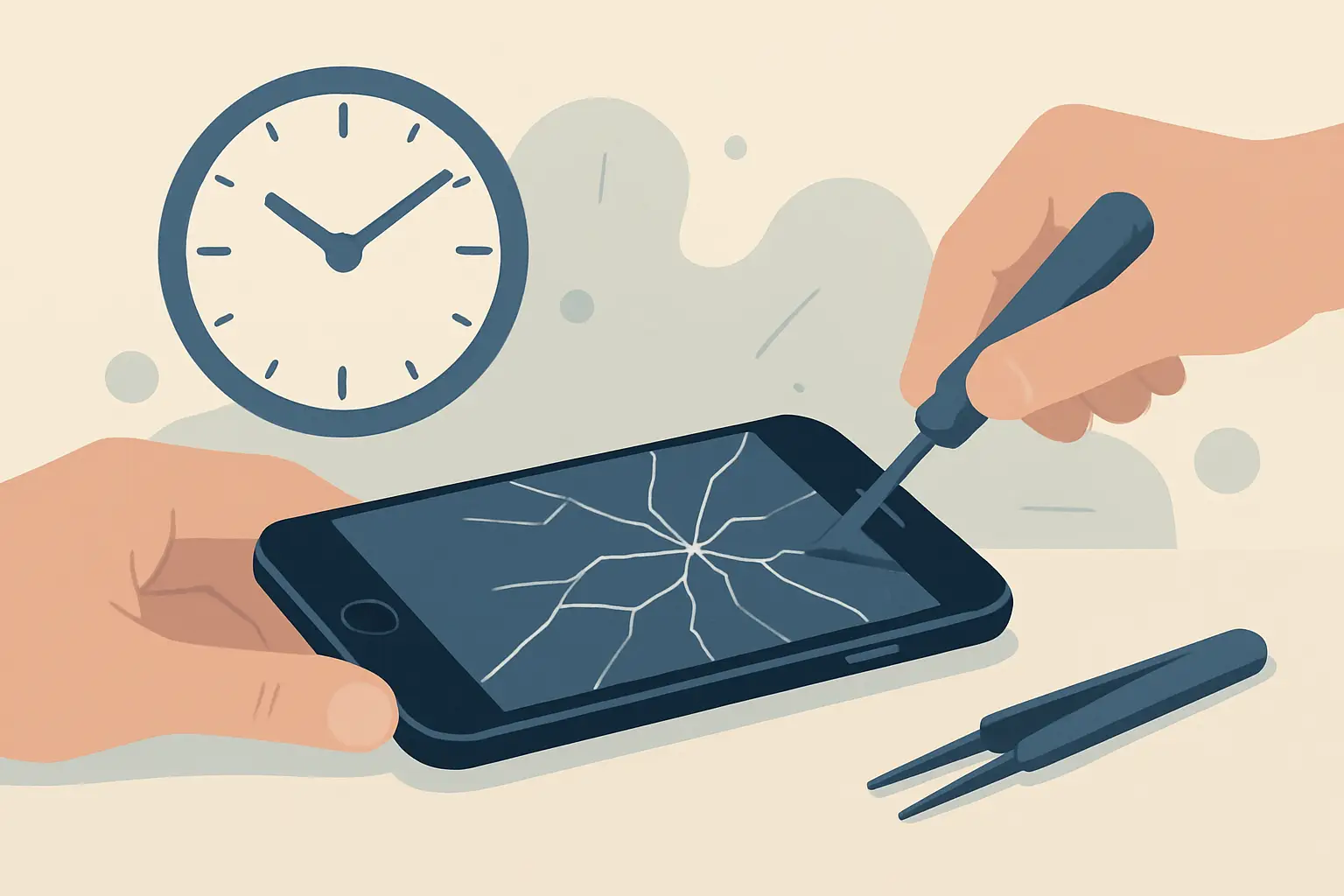
You drop your iPhone, the screen spiderwebs, and suddenly your whole day is on pause. The real question is not just cost – it’s time. Because if your phone is how you work, drive, pay, message your kid’s school, or run your business, the difference between 30 minutes and three days is everything.
Here’s the honest answer to how long does iPhone screen repair take: most standard screen replacements are a same-day job, and in a well-run shop with the right parts in stock, it can be done in under an hour. But there are a few real-world factors that can push that timeline out.
How long does iPhone screen repair take in real life?
For a straightforward cracked-screen replacement (touch still works, no liquid damage, phone powers on), typical in-shop repair time usually lands in the 30 to 90 minute range.
That window accounts for safe disassembly, transferring components (like the earpiece speaker and sensor assembly on many models), installing the new display, testing touch and brightness, verifying Face ID behavior, cleaning, sealing, and final quality checks. A “fast” repair is still a careful repair.
If you’re comparing that to mail-in options, you’re not talking minutes – you’re talking days. Shipping both ways, intake, queue time, and return delivery can easily turn into a week without anything going “wrong.” For most people around Middle Georgia who need their phone today, that’s a non-starter.
The biggest factors that change the timeline
Some screen repairs are truly routine. Others look routine until a technician opens the phone and sees what the impact actually did. These are the main reasons time varies.
1) Your iPhone model and screen type
Newer iPhones and higher-end models can take a bit longer, not because they’re “hard,” but because the displays are more complex and the repair requires more precision.
For example, OLED displays (common on many newer models) demand careful handling and higher-quality parts. Some models also have tighter internal tolerances or more involved adhesive/seal work. None of that should turn a normal screen job into an all-day event, but it can move a 30-minute repair closer to an hour.
2) Is it just the glass, or the whole display?
Most iPhone “screen repairs” are full display replacements, not just glass swaps. Glass-only repairs exist, but they require specialized equipment and usually take longer. A full display replacement is faster, more predictable, and often the more practical option for same-day turnaround.
If your touch is glitchy, the screen is black, you see lines, or it’s flickering, you’re almost certainly looking at a full display replacement.
3) Hidden damage from the drop
A cracked screen is sometimes the first symptom, not the only one. If the phone also took a corner hit, bent slightly, or shows frame damage, the repair can take longer. A warped frame can prevent the new screen from sitting correctly, and rushing that leads to lifting, gaps, pressure spots, or future cracking.
Drops can also damage small internal connectors or loosen components. A good shop will test for those issues before calling it done.
4) Water exposure (even if it “seems fine”)
If your phone has been exposed to water – rain, a sink, a spilled drink – the repair timeline changes because the priority changes. The screen replacement may still be needed, but the technician should check for corrosion and moisture inside before sealing it back up.
That diagnostic step can add time, and depending on what’s found, you may be looking at additional repairs or at least extra drying/cleaning work. The main trade-off here is speed versus risk. Closing up a damp phone quickly is how small problems become big ones.
5) Part availability and quality choice
Most delays in screen repair aren’t because the repair itself is slow. They’re because the right part isn’t immediately available.
If a shop keeps common iPhone screens in stock, you’re usually in great shape. If your model is less common, brand-new, or you want a specific quality tier, it may take longer to source. Waiting on a part turns a one-hour repair into a next-day pickup.
6) Face ID and sensor integrity
Customers often worry that replacing a screen will “break Face ID.” On iPhones, Face ID relies on a set of paired components that have to be handled correctly. A careful transfer of the original sensor assembly is essential.
If the phone already has damage in that area (top of the screen, near the notch or Dynamic Island area), troubleshooting may add time because the technician has to verify what’s screen-related versus what’s sensor-related. This is another place where the fastest repair is not always the best repair if testing gets skipped.
What the actual repair process looks like (and why it takes what it takes)
A professional screen replacement isn’t just “pop it off, pop it on.” The time comes from doing the steps that prevent repeat problems.
First, the device is inspected and tested: display, touch response, front camera, earpiece speaker, microphone behavior, charging, and any obvious housing damage.
Next comes disassembly and screen removal. That includes managing the adhesive and seals, removing protective plates, disconnecting the battery, and safely disconnecting the display.
Then the technician transfers required components from the old screen to the new one. This is where attention to detail matters. Misalignment or pinched cables can create new issues that weren’t there before.
Finally, the phone is reassembled, sealed appropriately, and tested again. A real test is not just “it turns on.” It’s verifying touch across the entire display, checking brightness and True Tone behavior (when applicable), confirming the proximity sensor works on calls, and making sure the front camera and Face ID behavior are normal.
Same-day repair versus “fast repair”: what you should ask
If you’re calling around and trying to get a realistic time estimate, ask questions that reveal whether the shop can truly deliver.
Ask if they have your exact model screen in stock today. Ask what the typical turnaround is when you walk in. Ask what testing they do after the repair. A shop that can explain their process clearly is usually a shop that runs an efficient workflow.
Also ask what warranty comes with the repair. Speed is great, but speed without a safety net is stressful. A strong warranty is how you know the shop expects the repair to hold up.
When a “screen repair” turns into more than a screen repair
Sometimes the reason you’re asking how long does iPhone screen repair take is because you already suspect it’s not just the screen.
If your iPhone won’t power on, won’t charge, overheats, has no service, or the back glass is shattered badly enough that the frame is compromised, the timeline can shift. You may still be in a same-day window, but the shop may need time to diagnose and confirm the root cause before installing parts.
That’s especially true if the phone has board-level damage from a hard impact or liquid. Advanced microsoldering repairs are a different category than a standard screen replacement, and they shouldn’t be rushed.
How to get your iPhone screen fixed faster (without cutting corners)
If you want the fastest turnaround, the goal is simple: reduce surprises.
Book an appointment if you can, or call ahead with your exact iPhone model so the shop can confirm stock. If your phone has had water exposure, say so upfront. If the frame is bent or the phone is acting weird beyond the screen, mention it. Those details help the technician plan the right workflow and avoid delays after you arrive.
Also, back up your phone if it’s still usable. Screen repair normally does not require wiping the phone, but having a backup is just good risk management. If the device is already unstable, the safest plan is to protect your data before anything changes.
What turnaround times usually look like at a speed-first local shop
In a shop built around same-day service, screen repair is one of the most common jobs, and the entire operation is designed to keep it moving: trained techs, a steady inventory of parts, and a process that doesn’t depend on shipping labels or long intake queues.
If you’re in the Warner Robins area and you want a fast, warranty-backed repair, Reboot Hub focuses on same-day phone repair with a 30-minute-or-less goal on many screen replacements, plus a low-price guarantee and lifetime warranty. You can check options or schedule at https://Www.rebootyourdevice.com.
FAQs that actually affect repair time
Can I wait in the store while it’s repaired?
Often, yes – if the shop has the part in stock and the workload allows it. Waiting is most realistic for standard models and straightforward cracks. If you come in during peak hours, you may still be same-day, just not immediate.
Does an iPhone screen repair take longer if the glass is “barely cracked”?
Usually no. In fact, lighter damage often means fewer complications. The time tends to increase with heavy impact, frame damage, or display issues like lines, flicker, or no touch.
Will my iPhone still be water-resistant after a screen replacement?
Water resistance can be affected any time a phone is opened. A careful shop will restore sealing as much as possible, but nobody should promise your iPhone is “like new” for water resistance afterward. If water protection is a top concern, ask how the shop handles seals and what precautions they recommend.
If your iPhone screen is broken, you don’t need a pep talk – you need your phone back. The best move is to pick a shop that can tell you a realistic timeframe, confirm parts availability, and stand behind the work, so you’re not dealing with the same problem again next week.